
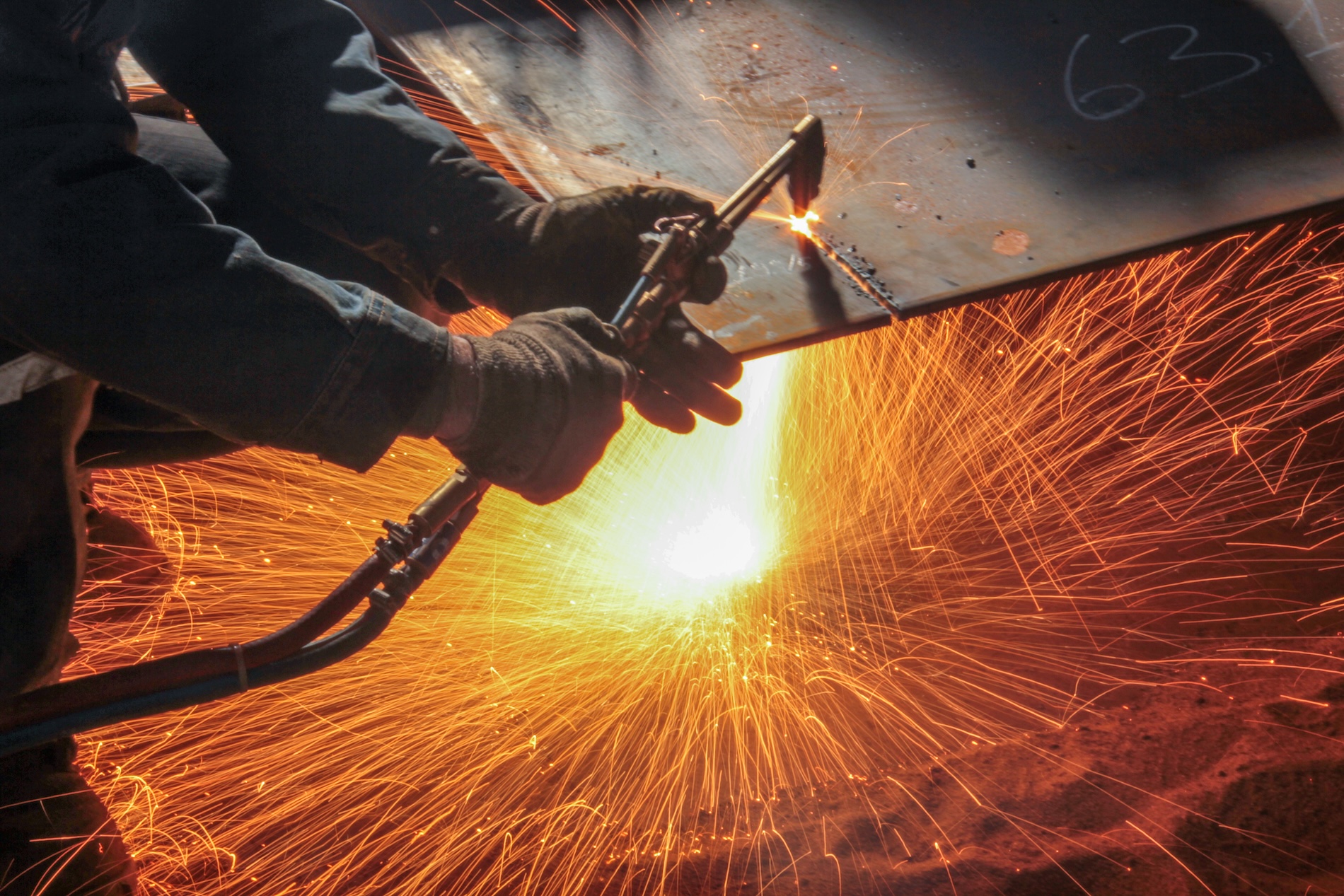
When comparing laser cutting vs. oxy-fuel cutting, laser cutting offers clear advantages in speed, precision, cut quality, and the ability to maintain tighter tolerances. When it comes to metal fabrication, the quality of the finished product starts long before welding or assembly. It starts with the cut.
Laser Cutting vs. Oxy-Fuel Cutting: Key Differences
For many applications, laser cutting offers significant advantages over traditional oxy-fuel cutting, particularly when speed, precision, edge quality, and tight tolerances matter. While oxy-fuel cutting still has its place, especially when working with very thick carbon steel, laser cutting is often the better choice for producing accurate, high-quality components efficiently.
Faster Cutting and Production
One of the biggest advantages of laser cutting is speed.
Laser cutting systems can move quickly through sheet and plate while producing highly accurate profiles. This becomes especially valuable when a project involves numerous parts, complex geometries, or repeat production runs.
Faster cutting isn’t just about getting one component off the table sooner. It can help shorten the entire fabrication process, allowing parts to move more quickly into forming, welding, assembly, and finishing.
Cleaner Cuts
Oxy-fuel cutting relies on a combustion process that creates a larger heat-affected area and can leave slag, scale, or rougher edges that require additional cleanup.
Laser cutting produces a narrower kerf and cleaner edge, reducing the amount of secondary processing required before a component moves to the next stage of fabrication.
Less grinding and cleanup means less labor, less handling, and a more efficient production process.
Greater Precision
Precision is where laser cutting really separates itself.
A CNC-controlled laser can follow detailed geometries with excellent accuracy, making it possible to produce intricate profiles, small features, holes, slots, and other details that can be more challenging to achieve consistently with oxy-fuel cutting.
That precision also improves repeatability. When a job calls for multiple identical components, laser cutting helps ensure that the first part and the hundredth part closely match.
Tighter Tolerances
In fabrication, small dimensional differences can create big headaches downstream.
Laser cutting’s accuracy allows components to be produced to tighter tolerances than are typically achievable with oxy-fuel cutting. Parts fit together more consistently, alignment is easier, and fabricators can spend less time compensating for dimensional variation during assembly and welding.
Better-fitting components can ultimately contribute to a better finished product.
Less Heat, Less Distortion
Because laser cutting concentrates energy into a small area, the heat-affected zone is generally much smaller than with oxy-fuel cutting.
Reducing unnecessary heat input helps limit distortion, particularly on thinner materials and components where flatness and dimensional accuracy are important.
The result is a part that comes off the cutting table closer to its intended final dimensions and ready for the next operation.
Laser Cutting vs. Oxy-Fuel Cutting
Oxy-fuel cutting remains a useful process and can be an excellent option for extremely thick carbon steel. But when a project demands speed, clean edges, precision, repeatability, and tight tolerances, laser cutting has a clear advantage.
For manufacturers and fabricators, those benefits add up:
- Faster production
- Cleaner cut edges
- Greater dimensional accuracy
- Tighter tolerances
- Excellent repeatability
- Less secondary grinding and cleanup
- Reduced heat-affected zones and distortion
- Better fit-up during fabrication and assembly
Better Cuts Make Better Parts
Cutting isn’t simply the first step in fabrication. It influences nearly every step that follows.
Starting with cleaner, more precise components can make forming, fitting, welding, and assembly more efficient while helping maintain consistent quality throughout production.
At Tech-Weld, laser cutting gives us the ability to produce accurate, repeatable components while keeping projects moving efficiently from raw material to finished fabrication.
When precision matters, the difference starts at the cut.